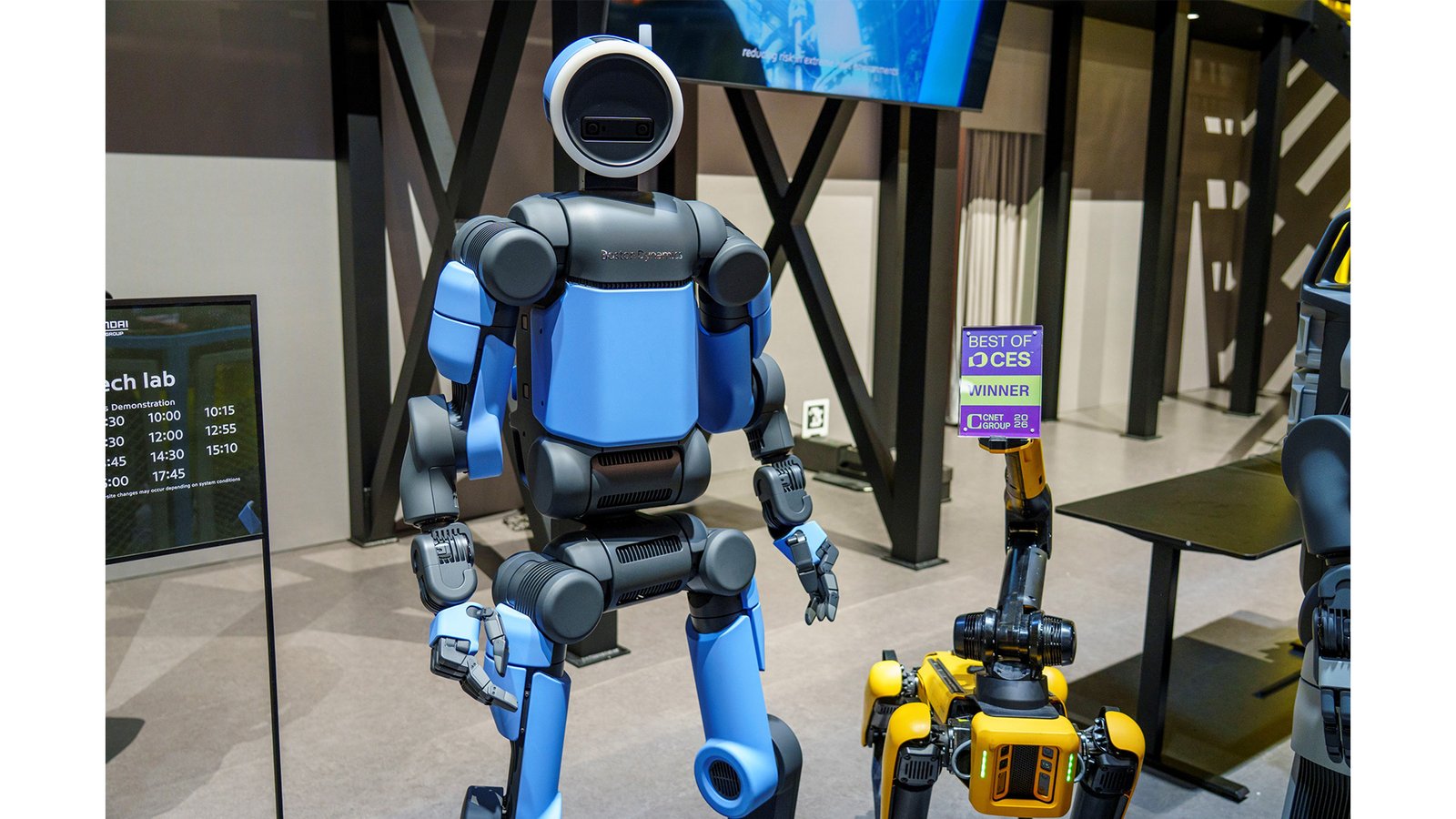
There is a particular kind of momentum in the technology industry that announces itself not through a single breakthrough, but through the simultaneous convergence of many. Physical AI is having that moment right now–and paying attention to where it is coming from, and why, tells you more than any single product launch can.
The term itself–physical AI–is simple enough. It describes AI systems that don’t just process data or generate content, but perceive, reason, and act in the real world–robots, autonomous vehicles, machines that adapt. Nvidia CEO Jensen Huang called it “the ChatGPT moment for robotics” at CES in January–a deliberate framing, and a useful one.
The ChatGPT comparison isn’t about hype. It signals that a technology once confined to research environments is being adopted for mainstream commercial deployment. That crossing is exactly what we are watching unfold from factory floors in Silicon Valley to stages in Shanghai.”
The West is building the stack
On the Western side, the physical AI push is fundamentally a platform race. The companies investing most aggressively aren’t primarily robotics companies–they’re infrastructure companies that see robotics as the next surface on which AI gets monetised.

Nvidia has released new Cosmos and GR00T open models for robot learning and reasoning, alongside the Blackwell-powered Jetson T4000 module, which delivers 4x greater energy efficiency for robotics computing. Arm has carved outan entirely new Physical AI business unit focused on semiconductor design for robotics and intelligent vehicles.
Siemens and Nvidia announced plans to build what they’re calling an Industrial AI Operating System, with ambitions to create the world’s first fully AI-driven adaptive manufacturing site. Then there’s Google, which last week brought its robotics software unit Intrinsic fully in-house–out of Alphabet’s “Other Bets” and into Google’s core.
The move positions Google to offer manufacturers a vertically integrated stack: AI models from DeepMind, deployment software from Intrinsic, and cloud infrastructure from Google Cloud. The Android analogy being floated internally is instructive. Android didn’t win smartphones by building the best phone. It won by becoming the layer everything else ran on.
That is precisely what Google is attempting with physical AI.
The enterprise implications are significant. A Deloitte survey of more than 3,200 global business leaders found that 58% are already using physical AI in some capacity, rising to 80% with plans over the next two years. The demand is there. The question has shifted from whether to adopt to how fast and on whose platform.
The East is building the machines
China’s physical AI story is different in character–and arguably more visceral. At this year’s Spring Festival Gala, humanoid robots from multiple Chinese startups performed kung fu routines, aerial flips, and choreographed dances before hundreds of millions of viewers–a sharp contrast from the stumbling prototypes that drew scepticism just a year prior.
It was a spectacle, yes. It was also a statement. China accounted for over 80% of global humanoid robot installations in 2025 and over half of the world’s industrial robots. That dominance is underpinned by structural advantages that go beyond software. China controls roughly 70% of the global lidar sensor market, leads in harmonic reducer production–the gears critical to robot movement–and has driven hardware costs down through the same economies of scale that propelled its EV industry.
Alibaba has entered the race with RynnBrain, an open-source AI model designed to help robots comprehend the physical world and identify objects–positioning itself alongside NVIDIA’s Cosmos and Google DeepMind’s Gemini Robotics in the foundation model layer. With over 140 domestic humanoid manufacturers and more than 330 humanoid models already unveiled, China’s push into embodied AI is no longer experimental–it’s commercial.
Why it matters beyond the headlines
The convergence of Western platform strategies and Eastern manufacturing scale is creating something genuinely new: a global physical AI ecosystem that is advancing on multiple fronts simultaneously, with different competitive advantages colliding.
What makes this moment distinct from prior robotics waves is the removal of the expertise bottleneck. Historically, deploying industrial robots required specialised engineering teams, months of custom programming, and a high tolerance for downtime. The platforms being built now–by Google, Nvidia, Siemens, and their Chinese equivalents–are explicitly designed to lower that barrier.
Companies like Vention, which raised US$110 million in January, claim their physical AI platforms can reduce automation project timelines from months to days. When that claim becomes routine, the economics of manufacturing change structurally.
There is also a geopolitical dimension that sits quietly beneath the product announcements. Every foundation model for robotics, every platform layer, every semiconductor architecture being developed right now carries with it questions of supply chain dependency, data sovereignty, and long-term infrastructure control.
The country–or company–that governs the software layer of physical AI will have unusual leverage over industrial operations globally for years to come.
Physical AI is not a trend. It is the next significant reconfiguration of how the world makes things, moves things, and operates at scale. The conversations happening now–from semiconductor boardrooms to factory floors in Shenzhen and Silicon Valley–are not preliminary. They are the thing itself, already underway.
(Photo by Hyundai Motor Group)
See also: Goldman Sachs and Deutsche Bank test agentic AI for trade surveillance
Want to learn more about AI and big data from industry leaders? Check out AI & Big Data Expo taking place in Amsterdam, California, and London. The comprehensive event is part of TechEx and co-located with other leading technology events. Click here for more information.
AI News is powered by TechForge Media. Explore other upcoming enterprise technology events and webinars here.