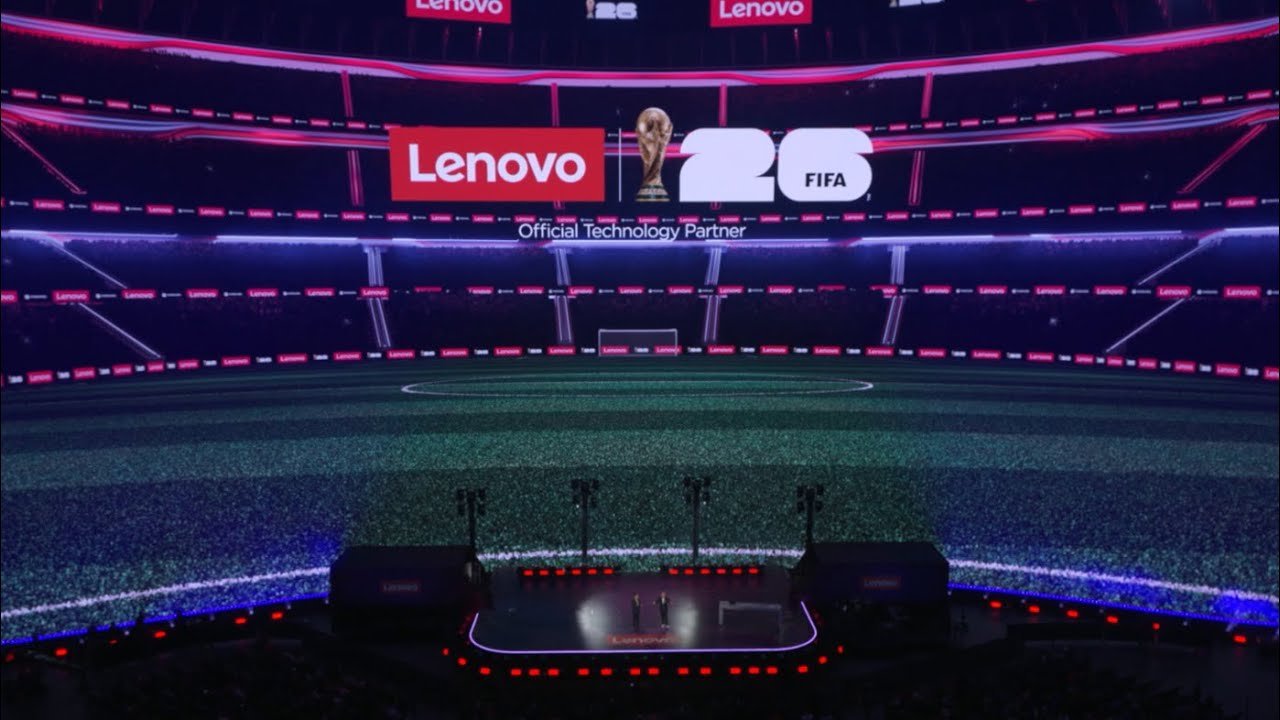
When Romy Gai, FIFA’s chief business officer, described the operational challenge of running a 48-team World Cup across Canada, Mexico and the United States, he was not talking about technology. He was talking about complexity.
Previous World Cups relied on local organising committees to absorb much of the logistical load. For 2026, FIFA is running operations directly. Six billion people are expected to watch. There are 104 matches, up from 64 in Qatar. There are 48 teams instead of 32, 180-plus broadcasters, and no single national infrastructure to lean on. The scale is genuinely new.
The AI strategy FIFA unveiled at Lenovo Tech World in Hong Kong this week is best understood against that backdrop. Football AI Pro, AI-enabled 3D player avatars, and a next-generation Referee View are the headline announcements. Butthe product decisions themselves reflect something more structural: an organisation that has decided AI is not an enhancement to how it runs football’s biggest event, but it is how the event gets run.
Football AI Pro is a generative AI knowledge assistant that will be made available to all 48 teams competing at the 2026 World Cup. It is built on FIFA’s Football Language Model and trained on hundreds of millions of FIFA-owned data points. It generates pre- and post-match analysis in text, video, graphs and 3D visualisations, supports prompts in multiple languages, and will not be used during live play.

The democratisation argument behind it is straightforward. At the highest level of the game, access to sophisticated match analysis depends heavily on a team’s financial resources. A tier-one footballing nation has a dedicated analytics department. A team competing at its first World Cup does not. Football AI Pro is designed to give every team the same analytical baseline.
That ambition is real, but it is also worth understanding as an enterprise AI deployment challenge. Delivering consistent, tournament-wide intelligence across 48 teams in three countries, in multiple languages, against a match schedule that runs for weeks, is not a small infrastructure problem. It is the kind of workload that requires exactly the hybrid AI architecture
Lenovo has been building its enterprise positioning.
The referee camera is about transparency, not television
The updated Referee View is being framed in broadcast terms, and it will look good on screen. AI-powered stabilisation smooths footage captured from the referee’s body camera in real time, reducing the motion blur that made the original version hard to watch during fast play.
The more significant purpose is transparency. VAR has been one of the most contested technologies in football, partly because the decision-making process is difficult for fans to follow and partly because the imagery used to communicate those decisions has often been unclear. Better referee footage, delivered in real time, changes both of those problems.
The first version of Referee View was trialled at the FIFA Club World Cup last year. The updated version for 2026 is a meaningful technical step forward, but the real test is whether it shifts audience perception of officiating decisions. If it does, it becomes a governance technology as much as a broadcast one.
3D avatars and the offside problem
The AI-enabled 3D player avatar system addresses a specific and persistent pain point: semi-automated offside technology. The existing system works, but the imagery it produces to explain offside decisions has not always been convincing. The lines are hard to read, the angles are counterintuitive, and fans routinely dispute calls that the technology correctly identified.
The new system scans players to create precise 3D models, with each scan taking approximately one second. During matches, those models are used to track players more accurately through fast or obstructed movements.
When an offside decision is referred to VAR, the 3D model produces imagery that is both more accurate and easier to understand. It was tested at the FIFA Intercontinental Cup last year, where Flamengo and Pyramids FC players were scanned ahead of their match.
The underlying logic is the same as the referee camera: better data, communicated more clearly, reduces the legitimacy gap between the decision and the audience’s acceptance of it.
The intelligent command centre
The least-discussed element of the FIFA-Lenovo partnership is arguably the most operationally significant. FIFA has built what Gai described as an intelligent command centre that connects real-time data across departments, matches, venues and broadcasters in a single operational view.
In a tournament running across three countries with over 180 broadcasters and six billion expected viewers, operational coordination is the constraint that everything else depends on. The command centre is effectively the enterprise AI backbone behind the public-facing Football AI announcements.
Gai’s point about removing local organising committees is worth sitting with. It means FIFA is taking on operational responsibility for functions that were previously distributed across national bodies with local knowledge and localrelationships. AI is not just supporting that decision; it is what makes the decision viable.
The Football Language Model and what comes after 2026
Football AI Pro is built on FIFA’s Football Language Model, a domain-specific model trained on FIFA’s own data. That is a significant asset. A general-purpose language model can answer questions about football. A model trained on hundreds of millions of FIFA-owned data points can generate validated, tournament-specific intelligence that a general model cannot replicate.
The implications extend beyond 2026. FIFA has stated that Football AI Pro will eventually be made available to fans, not just teams. The 211 member federations that make up world football’s governing structure are also in scope. If the model performs at the World Cup, it becomes the foundation for a much longer democratisation project, one that extends analytical capability to national associations and competitions that currently have almost none.
That is the larger enterprise AI story behind the announcements this week. The World Cup is the proof of concept. What FIFA builds on top of it is the actual deployment.
See also: How physical AI integration accelerates vehicle innovation
Want to learn more about AI and big data from industry leaders? Check out AI & Big Data Expo taking place in Amsterdam, California, and London. The comprehensive event is part of TechEx and is co-located with other leading technology events including the Cyber Security & Cloud Expo. Click here for more information.
AI News is powered by TechForge Media. Explore other upcoming enterprise technology events and webinars here.