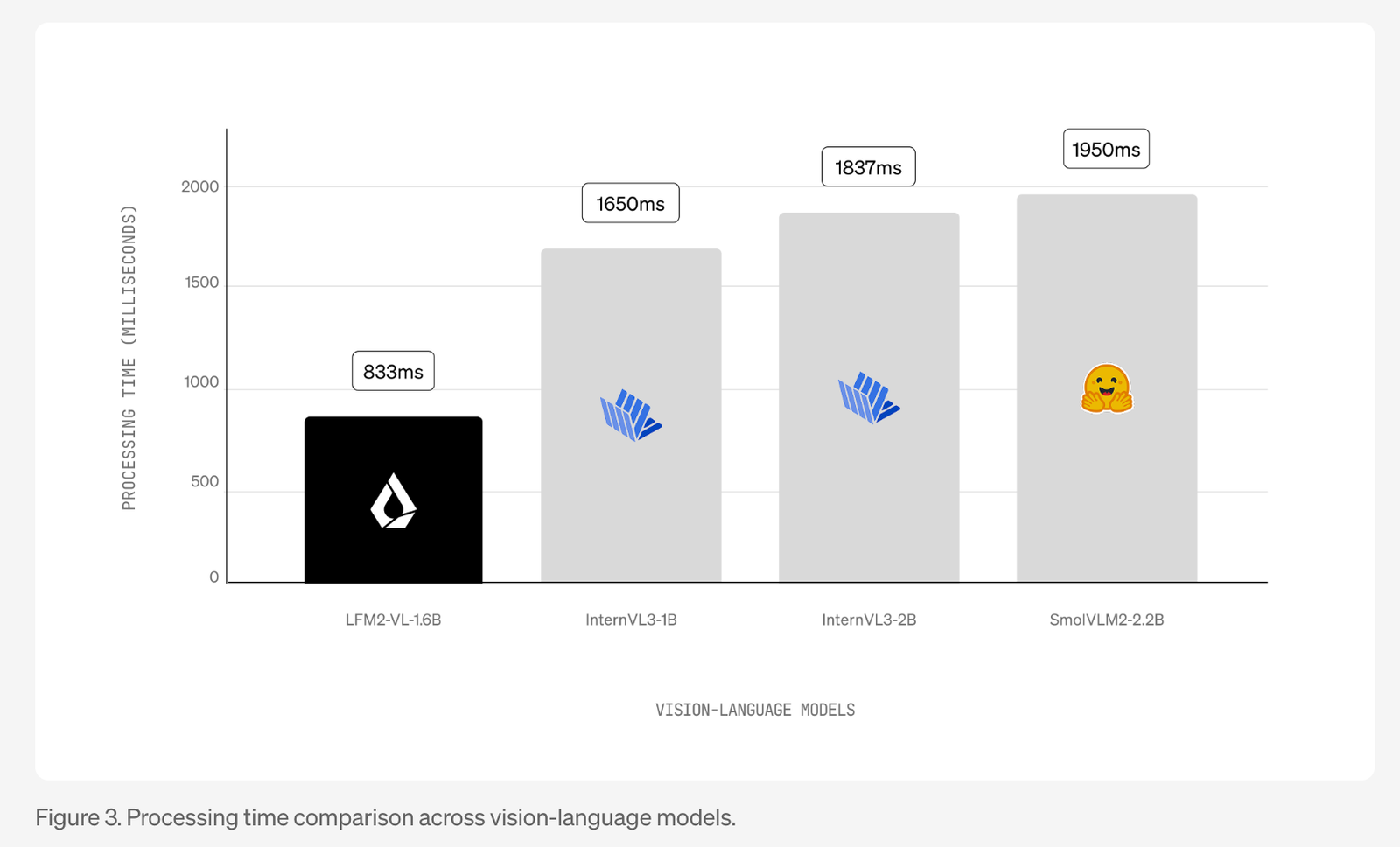
Liquid AI has officially released LFM2-VL, a new family of vision-language foundation models optimized for low-latency, on-device deployment. With two highly efficient variants—LFM2-VL-450M and LFM2-VL-1.6B—this launch marks a significant leap in bringing multimodal AI to smartphones, laptops, wearables, and embedded systems without compromising speed or accuracy.
Unprecedented Speed and Efficiency
LFM2-VL models are engineered to deliver up to 2× faster GPU inference compared to existing vision-language models, while maintaining competitive benchmark performance on tasks like image description, visual question answering, and multimodal reasoning. The 450M-parameter variant is tailored for highly resource-constrained environments, while the 1.6B-parameter version offers greater capability while still remaining lightweight enough for single-GPU or high-end mobile use.
Technical Innovations
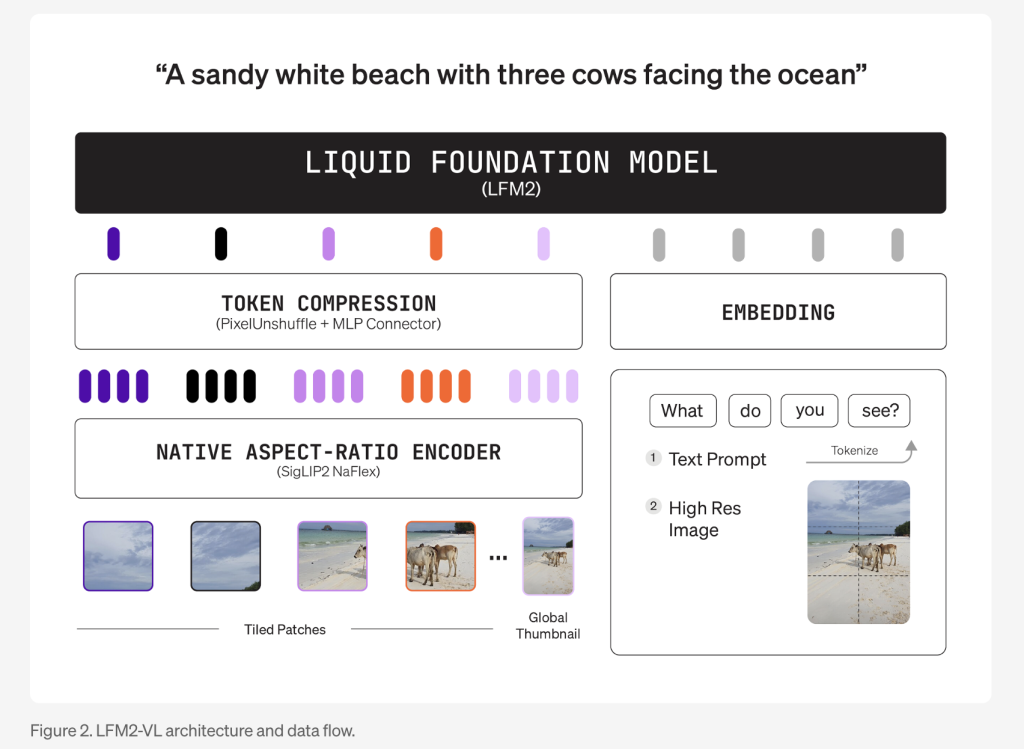
- Modular Architecture: LFM2-VL combines a language model backbone (LFM2-1.2B or LFM2-350M), a SigLIP2 NaFlex vision encoder (400M or 86M parameters), and a multimodal projector with a “pixel unshuffle” technique that dynamically reduces image token counts for faster processing.
- Native Resolution Handling: Images are processed at their native resolution up to 512×512 pixels without distortion from upscaling. Larger images are split into non-overlapping 512×512 patches, preserving detail and aspect ratio. The 1.6B model also encodes a downscaled thumbnail of the full image for global context understanding.
- Flexible Inference: Users can tune the speed-quality tradeoff at inference time by adjusting maximum image tokens and patch count, allowing real-time adaptation to device capabilities and application needs.
- Training: The models were first pre-trained on the LFM2 backbone, then jointly mid-trained to fuse vision and language capabilities using a progressive adjustment of text-to-image data ratios, and finally fine-tuned for image understanding on approximately 100 billion multimodal tokens.
Benchmark Performance
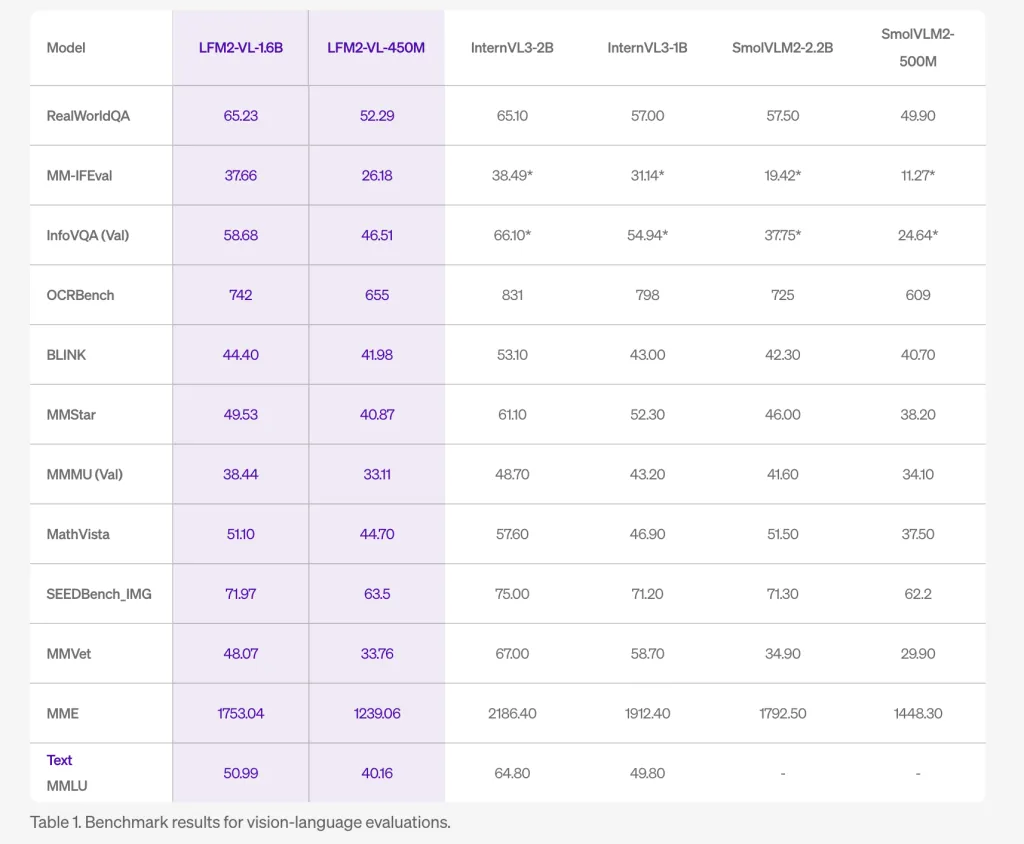
LFM2-VL delivers competitive results on public benchmarks such as RealWorldQA, MM-IFEval, and OCRBench, rivaling larger models like InternVL3 and SmolVLM2, but with a smaller memory footprint and much faster processing—making it ideal for edge and mobile applications.
Both model sizes are open-weight and downloadable on Hugging Face under an Apache 2.0-based license, permitting free use for research and commercial use by companies. Larger enterprises must contact Liquid AI for a commercial license. The models integrate seamlessly with Hugging Face Transformers and support quantization for further efficiency gains on edge hardware.

Use Cases and Integration
LFM2-VL is designed for developers and enterprises seeking to deploy fast, accurate, and efficient multimodal AI directly on devices—reducing cloud dependency and enabling new applications in robotics, IoT, smart cameras, mobile assistants, and more. Example applications include real-time image captioning, visual search, and interactive multimodal chatbots.
Getting Started
- Download: Both models are available now on the Liquid AI Hugging Face collection.
- Run: Example inference code is provided for platforms like llama.cpp, supporting various quantization levels for optimal performance on different hardware.
- Customize: The architecture supports integration with Liquid AI’s LEAP platform for further customization and multi-platform edge deployment.
In summary, Liquid AI’s LFM2-VL sets a new standard for efficient, open-weight vision-language models on the edge. With native resolution support, tunable speed-quality tradeoffs, and a focus on real-world deployment, it empowers developers to build the next generation of AI-powered applications—anywhere, on any device.
Check out the Technical Details and Models on Hugging Face. Feel free to check out our GitHub Page for Tutorials, Codes and Notebooks. Also, feel free to follow us on Twitter and don’t forget to join our 100k+ ML SubReddit and Subscribe to our Newsletter.

Asif Razzaq is the CEO of Marktechpost Media Inc.. As a visionary entrepreneur and engineer, Asif is committed to harnessing the potential of Artificial Intelligence for social good. His most recent endeavor is the launch of an Artificial Intelligence Media Platform, Marktechpost, which stands out for its in-depth coverage of machine learning and deep learning news that is both technically sound and easily understandable by a wide audience. The platform boasts of over 2 million monthly views, illustrating its popularity among audiences.