How a semiconductor veteran turned over a century of horticultural wisdom into AI-led competitive advantage
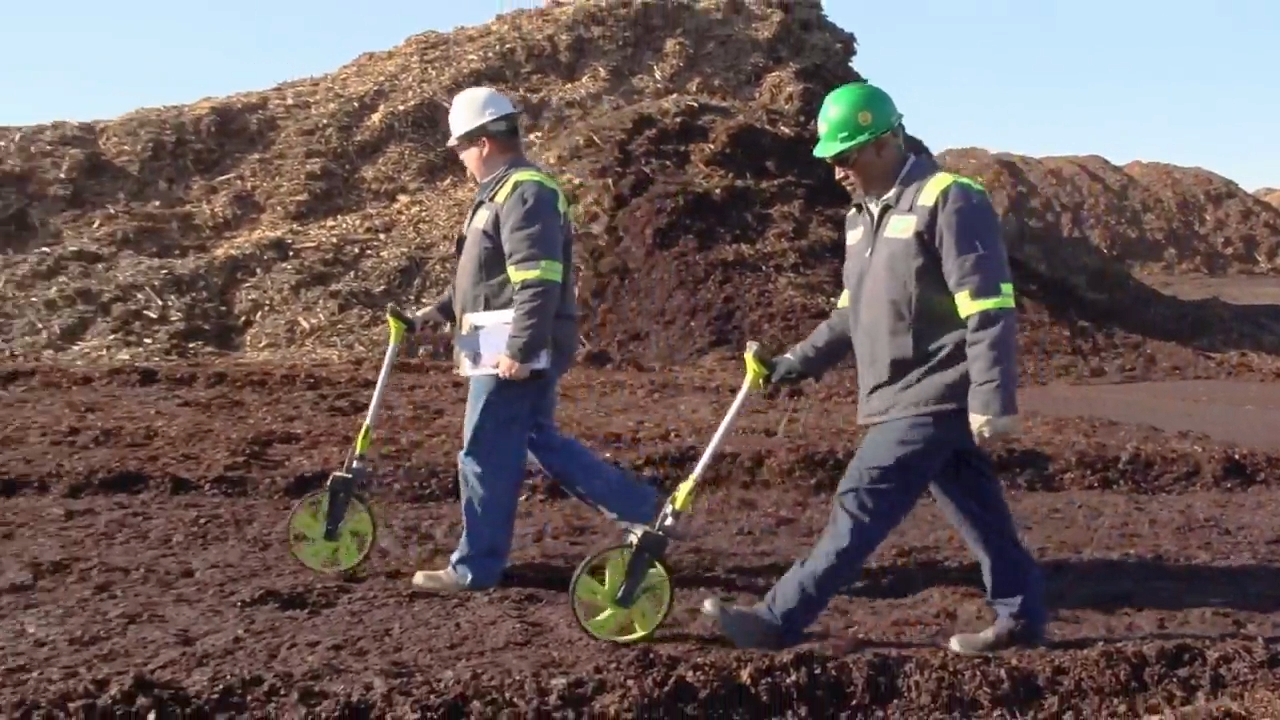
For decades, a ritual played out across ScottsMiracle-Gro’s media facilities. Every few weeks, workers walked acres of towering compost and wood chip piles with nothing more than measuring sticks. They wrapped rulers around each mound, estimated height, and did what company President Nate Baxter now describes as “sixth-grade geometry to figure out volume.”
Today, drones glide over those same plants with mechanical precision. Vision systems calculate volumes in real time. The move from measuring sticks to artificial intelligence signals more than efficiency. It is the visible proof of one of corporate America’s most unlikely technology stories.
The AI revolution finds an unexpected leader
Enterprise AI has been led by predictable players. Software companies with cloud-native architectures. Financial services firms with vast data lakes. Retailers with rich digital touchpoints. Consumer packaged goods companies that handle physical products like fertilizer and soil were not expected to lead.

Yet ScottsMiracle-Gro has realized more than half of a targeted $150 million in supply chain savings. It reports a 90 percent improvement in customer service response times. Its predictive models enable weekly reallocation of marketing resources across regional markets.
A Silicon Valley veteran bets on soil science
Baxter’s path to ScottsMiracle-Gro (SMG) reads like a calculated pivot, not a corporate rescue. After two decades in semiconductor manufacturing at Intel and Tokyo Electron, he knew how to apply advanced technology to complex operations.
“I sort of initially said, ‘Why would I do this? I’m running a tech company. It’s an industry I’ve been in for 25 years,’” Baxter recalls of his reaction when ScottsMiracle-Gro CEO Jim Hagedorn approached him in 2023. The company was reeling from a collapsed $1.2 billion hydroponics investment and facing what he describes as “pressure from a leverage standpoint.”
His wife challenged him with a direct prompt. If you are not learning or putting yourself in uncomfortable situations, you should change that.
Baxter saw clear parallels between semiconductor manufacturing and SMG’s operations. Both require precision, quality control, and the optimization of complex systems. He also saw untapped potential in SMG’s domain knowledge. One hundred fifty years of horticultural expertise, regulatory know-how, and customer insight had never been fully digitized.
“It became apparent to me whether it was on the backend with data analytics, business process transformation, and obviously now with AI being front and center of the consumer experience, a lot of opportunities are there,” he explains.
The declaration that changed everything
The pivot began at an all-hands meeting. “I just said, you know, guys, we’re a tech company. You just don’t know it yet,” Baxter recalls. “There’s so much opportunity here to drive this company to where it needs to go.”
The first challenge was organizational. SMG had evolved into functional silos. IT, supply chain, and brand teams ran independent systems with little coordination. Drawing on his experience with complex technology organizations, Baxter restructured the consumer business into three business units. General managers became accountable not just for financial results but also for technology implementation within their domains.
“I came in and said, we’re going to create new business units,” he explains. “The buck stops with you and I’m holding you accountable not only for the business results, for the quality of the creative and marketing, but for the implementation of technology.”
To support the new structure, SMG set up centers of excellence for digital capabilities, insights and analytics, and creative functions. The hybrid design placed centralized expertise behind distributed accountability.
Mining corporate memory for AI gold
Turning legacy knowledge into machine-ready intelligence required what Fausto Fleites, VP of Data Intelligence, calls “archaeological work.” The team excavated decades of business logic embedded in legacy SAP systems and converted filing cabinets of research into AI-ready datasets. Fleites, a Cuban immigrant with a doctorate from FIU who led Florida’s public hurricane loss model before roles at Sears and Cemex, understood the stakes.
“The costly part of the migration was the business reporting layer we have in SAP Business Warehouse,” Fleites explains. “You need to uncover business logic created in many cases over decades.”
SMG chose Databricks as its unified data platform. The team had Apache Spark expertise. Databricks offered strong SAP integration and aligned with a preference for open-source technologies that minimize vendor lock-in.
The breakthrough came through systematic knowledge management. SMG built an AI bot using Google’s Gemini large language model to catalog and clean internal repositories. The system identified duplicates, grouped content by topic, and restructured information for AI consumption. The effort reduced knowledge articles by 30 percent while increasing their utility.
“We used Gemini LLMs to actually categorize them into topics, find similar documents,” Fleites explains. A hybrid approach that combined modern AI with techniques like cosine similarity became the foundation for later applications.
Building AI systems that actually understand fertilizer
Early trials with off-the-shelf AI exposed a real risk. General-purpose models confused products designed for killing weeds with those for preventing them. That mistake can ruin a lawn.
“Different products, if you use one in the wrong place, would actually have a very negative outcome,” Fleites notes. “But those are kind of synonyms in certain contexts to the LLM. So they were recommending the wrong products.”
The solution was a new architecture. SMG created what Fleites calls a “hierarchy of agents.” A supervisor agent routes queries to specialized worker agents organized by brand. Each agent draws on deep product knowledge encoded from a 400-page internal training manual.
The system also changes the conversation. When users ask for recommendations, the agents start with questions about location, goals, and lawn conditions. They narrow possibilities step by step before offering suggestions. The stack integrates with APIs for product availability and state-specific regulatory compliance.
From drones to demand forecasting across the enterprise
The transformation runs across the company. Drones measure inventory piles. Demand forecasting models analyze more than 60 factors, including weather patterns, consumer sentiment, and macroeconomic indicators.
These predictions enable faster moves. When drought struck Texas, the models supported a shift in promotional spending to regions with favorable weather. The reallocation helped drive positive quarterly results.
“We not only have the ability to move marketing and promotion dollars around, but we’ve even gotten to the point where if it’s going to be a big weekend in the Northeast, we’ll shift our field sales resources from other regions up there,” Baxter explains.
Consumer Services changed as well. AI agents now process incoming emails through Salesforce, draft responses based on the knowledge base, and flag them for brief human review. Draft times dropped from ten minutes to seconds and response quality improved.
The company emphasizes explainable AI. Using SHAP, SMG built dashboards that decompose each forecast and show how weather, promotions, or media spending contribute to predictions.
“Typically, if you open a prediction to a business person and you don’t say why, they’ll say, ‘I don’t believe you,’” Fleites explains. Transparency made it possible to move resource allocation from quarterly to weekly cycles.
Competing like a startup
SMG’s results challenge assumptions about AI readiness in traditional industries. The advantage does not come from owning the most sophisticated models. It comes from combining general-purpose AI with unique, structured domain knowledge.
“LLMs are going to be a commodity,” Fleites observes. “The strategic differentiator is what is the additional level of [internal] knowledge we can fit to them.”
Partnerships are central. SMG works with Google Vertex AI for foundational models, Sierra.ai for production-ready conversational agents, and Kindwise for computer vision. The ecosystem approach lets a small internal team recruited from Meta, Google, and AI startups deliver outsized impact without building everything from scratch.
Talent follows impact. Conventional wisdom says traditional companies cannot compete with Meta salaries or Google stock. SMG offered something different. It offered the chance to build transformative AI applications with immediate business impact.
“When we have these interviews, what we propose to them is basically the ability to have real value with the latest knowledge in these spaces,” Fleites explains. “A lot of people feel motivated to come to us” because much of big tech AI work, despite the hype, “doesn’t really have an impact.”
Team design mirrors that philosophy. “My direct reports are leaders and not only manage people, but are technically savvy,” Fleites notes. “We always are constantly switching hands between developing or maintaining a solution versus strategy versus managing people.” He still writes code weekly. The small team of 15 to 20 AI and engineering professionals stays lean by contracting out implementation while keeping “the know-how and the direction and the architecture” in-house.
When innovation meets immovable objects
Not every pilot succeeded. SMG tested semi-autonomous forklifts in a 1.3 million square foot distribution facility. Remote drivers in the Philippines controlled up to five vehicles at once with strong safety records.
“The technology was actually really great,” Baxter acknowledges. The vehicles could not lift enough weight for SMG’s heavy products. The company paused implementation.
“Not everything we’ve tried has gone smoothly,” Baxter admits. “But I think another important point is you have to focus on a few critical ones and you have to know when something isn’t going to work and readjust.”
The lesson tracks with semiconductor discipline. Investments must show measurable returns within set timeframes. Regulatory complexity adds difficulty. Products must comply with EPA rules and a patchwork of state restrictions, which AI systems must navigate correctly.
The gardening sommelier and agent-to-agent futures
The roadmap reflects a long-term view. SMG plans a “gardening sommelier” mobile app in 2026 that identifies plants, weeds, and lawn problems from photos and provides instant guidance. A beta already helps field sales teams answer complex product questions by querying the 400-page knowledge base.
The company is exploring agent-to-agent communication so its specialized AI can interface with retail partners’ systems. A customer who asks a Walmart chatbot for lawn advice could trigger an SMG query that returns accurate, regulation-compliant recommendations.
SMG has launched AI-powered search on its website, replacing keyword systems with conversational engines based on the internal stack. The future vision pairs predictive models with conversational agents so the system can reach out when conditions suggest a customer may need help.
What traditional industries can learn
ScottsMiracle-Gro's transformation offers a clear playbook for enterprises. The advantage doesn't come from deploying the most sophisticated models. Instead, it comes from combining AI with proprietary domain knowledge that competitors can't easily replicate.
By making general managers responsible for both business results and technology implementation, SMG ensured AI wasn't just an IT initiative but a business imperative. The 150 years of horticultural expertise only became valuable when it was digitized, structured, and made accessible to AI systems.
Legacy companies competing for AI engineers can't match Silicon Valley compensation packages. But they can offer something tech giants often can't: immediate, measurable impact. When engineers see their weather forecasting models directly influence quarterly results or their agent architecture prevent customers from ruining their lawns, the work carries weight that another incremental improvement to an ad algorithm never will.
“We have a right to win,” Baxter says. “We have 150 years of this experience.” That experience is now data, and data is the company’s competitive edge. ScottsMiracle-Gro didn’t outspend its rivals or chase the newest AI model. It turned knowledge into an operating system for growth. For a company built on soil, its biggest breakthrough might be cultivating data.